











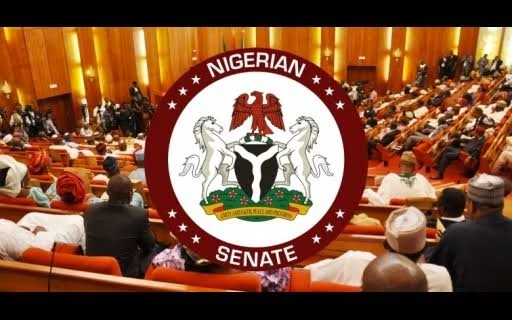
Nigeria’s Senate amended its Standing Orders in a closed-door session on Tuesday, May 5, introducing sweeping eligibility criteria that fundamentally redraw the boundaries of who can aspire to lead the red chamber. (Alexa News Network) The language of the amendment is precise, deliberate, and — to any discerning democratic mind — deeply alarming. “A Senator shall not be eligible to contest as a Presiding Officer unless he has been elected and served as a Senator for at least two terms of eight years, one term of which shall immediately precede such election.” (The Sun Nigeria) These are not mere procedural adjustments. They are instruments of political architecture, engineered to permanently reshape the landscape of legislative power.
The amended rule further entrenches this exclusion by stating that no senator shall be eligible to contest for any principal office unless he has served two consecutive terms immediately preceding nomination — effectively shutting out every senator-elect who was not a member of both the 9th and 10th National Assembly from contesting any leadership role in the 11th Assembly. (Punch) In one covert session, the Nigerian Senate did not refine its rules. It fortified its throne.
The pretence of institutional reform collapses entirely when the political context is examined with intellectual honesty. The amendment is widely regarded as a calculated manoeuvre designed to neutralise the growing ambition of Imo State Governor Hope Uzodimma to contest for Senate President in 2027. (The Sun Nigeria) The crisis reached its tipping point when the APC Governors Forum allegedly positioned Uzodimma as a frontline replacement for Senate President Godswill Akpabio (Politics Nigeria) — a prospect that clearly rattled the foundations of the existing Senate establishment. Others ensnared in the web of this exclusion include high-profile figures such as Kabiru Marafa and Adams Oshiomhole (Blueprint Newspapers Limited) — men whose political weight and national visibility evidently made the Senate’s incumbents deeply uncomfortable.
The Senate’s response was not democratic deliberation. It was legislative self-defence — swift, secretive, and surgical.
A ranking senator, speaking under the shield of anonymity, was unsparing in his verdict: “This is clearly a pre-emptive strategy to determine who gets what in 2027. It limits competition and ensures that only those already within the system can aspire to leadership.” (The Sun Nigeria) This is not the voice of opposition grandstanding. This is an insider’s confession — an acknowledgment, from within the very chamber that passed this amendment, that what occurred on May 5 was not governance. It was consolidation of power, executed with the cold precision of those who understand exactly what is at stake in 2027.
The dangers embedded in this amendment are profound and far-reaching. By codifying two consecutive terms as the gateway to legislative leadership, the Senate has inaugurated a gerontocracy — a closed aristocracy of incumbency where institutional longevity supersedes democratic merit, public mandate, and legislative vision. It renders the votes of millions of Nigerians who may elect a dynamic, transformative senator in 2027 constitutionally meaningless the moment that senator dares to aspire beyond their seat. That this seismic rule change was adopted after a closed-door session lasting nearly three hours (Thetrumpet) — without public debate, without civil society input, without constitutional scrutiny — is an affront to every principle of open governance that Nigeria’s democracy professes to uphold.
Proponents insist that the complexity of legislative leadership demands senators of proven parliamentary experience and procedural competence. (Alexa News Network) That argument is not without theoretical merit. But it disintegrates under rigorous examination. True democratic competence is validated through open contest, rigorous public scrutiny, and the ultimate verdict of one’s peers — not manufactured through blanket exclusionary rules crafted behind closed doors by those whose primary motivation is self-preservation. Nigeria’s Senate has never suffered from a shortage of long-serving lawmakers. It has suffered from a chronic deficit of accountability, transparency, and genuine legislative independence. Longevity in that chamber is no guarantee of virtue. In many cases, it has been the very incubator of the dysfunction that Nigerians have long demanded be dismantled.
The Senate President stands second in the Nigerian presidential line of succession (Wikipedia) — a constitutional reality that makes the integrity of the process by which that office is contested a matter of national, not merely parliamentary, consequence. To allow that process to be shaped by covert rule amendments, driven by factional interests and personal political anxieties, is to corrupt one of the most consequential democratic mechanisms in the Nigerian state.
What transpired on May 5, 2026, was not legislative reform. It was an act of institutional self-interest, executed in the shadows, justified with the language of tradition, and aimed squarely at ensuring that the corridors of Senate power remain the exclusive preserve of those already walking them. Nigeria’s democracy deserves far better than a Senate that rewrites the rules of competition the moment it fears losing.
The Senate did not serve Nigeria on May 5, 2026. It served itself — and it did so without apology, without transparency, and without shame.
For comments, reflections and further conversation:
Email: samuelagogo4one@yahoo.com
Phone: +2347062760296