












(SINL NIGERIA) The Coordinating Minister of Health and Social Welfare Professor, Muhammad Ali Pate, has reaffirmed that government has undertaken deliberate and strategic initiatives aimed at enhancing midwifery and improve maternal and child health outcomes across the country.
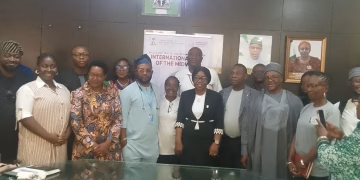
The Coordinating Minister gave the assertion in his speech during Ministerial Press briefing in commomeration of 2026 International Day of the Midwife, held in Abuja.
Pate, represented by the Director, Hospital Services, Dr. Abisola Adegoke said midwives are the frontline of maternal and new-born healthcare delivery particularly in underserved and rural communities.
He noted that no health system can provide optimal maternal and child health services without having adequate number of skilled midwives, adding that they play an indispensable role in safeguarding lives, providing care from pregnancy through childbirth and beyond.
He revealed that the Ministry has launched the Nigeria Strategic Directions for Nursing and Midwifery 2025–2030, a comprehensive national roadmap designed to strengthen education, expand workforce capacity, leadership, and service delivery for nurses and midwives.
He further explained that through this strategy, government is expanding training institutions and increasing student intake for midwifery programmes, standardizing and modernizing midwifery education to meet global best practices, creating additional employment opportunities and removing barriers to recruitment, and promoting equitable deployment of midwives, especially to rural and underserved areas
Professor Pate added that the Ministry has prioritized continuous professional development for midwives, by investing in competency-based training and life-saving skills to improve outcomes for mothers and new-borns, and it is targeting high-burden areas through the Maternal Mortality Reduction Innovation Initiative (MAMII) with a view to ensuring that no woman dies while giving birth.
According to the Minister, other programmes targeted at improving reproductive health are the Basic Emergency Obstetric and Newborn Care (BEmONC) and the Comprehensive Emergency Obsterric and Newborn Care (CEmONC). “All these interventions with the involvement of midwives, are intended to improve care and country’s health indices.” He further noted.
Commenting on the theme “One Million More Midwives”, Professor Pate described it as appropriate and timely as it serves as a reminder of the critical shortage of Midwives globally, which Nigeria health institutions are not exemptional, reiterating that the need to scale up the midwifery workforce is a critical strategy for improving maternal, newborn, and child health outcomes.
He revealed that there is ongoing partnerships to ensure that midwives are equipped with the tools, supplies, and supportive work environments they need. “There is improvement in welfare, motivation, and retention efforts, recognizing that a supported workforce delivers better care” he said.
He acknowledged the unwavering support of development partners to this mission and promised to scale up the production of midwives to meet national demand, strengthen primary healthcare systems, where midwives play a central role, invest in digital health systems to support service delivery, improve working conditions and professional development opportunities, and deepen community engagement to promote skilled birth attendance.
He appreciates “To our midwives across the country, we see you, we value you, we celebrate your dedication, resilience, and compassion. You are the backbone of safe motherhood and healthy families.To our partners and stakeholders, we appreciate your unwavering support to this mission. Together, we can ensure that every pregnancy is safe, every birth is attended by skilled hands, and every child has a healthy start to life.”
In her welcome address, the Permanent Secretary Federal Ministry of Health and Social Welfare, Daju Kachollom S. mni, represented by Dr Okpako Okpikpi, Director, Teaching Hospitals, said the event offered an opportunity not only to recognize the tireless efforts of midwives, but also to reflect on the urgent need to strengthen our health systems.
“Today, we gather to celebrate the dedication, resilience, and invaluable contributions of midwives to the health and wellbeing of women, new-borns, and families across Nigeria. Midwives remain at the heart of our healthcare system, providing essential care before, during, and after childbirth, often in the most challenging conditions.”
She therefore, restated that the Ministry remains committed to supporting midwives through improved training, better working conditions, and sustained investments in healthcare infrastructure, and acknowledged the vital support of partners and stakeholders who continue to work with the Ministry in advancing maternal and child health in Nigeria.