















Every election season in Nigeria produces its familiar cast of characters. There are the triumphant, who emerge from party congresses clutching tickets and making victory speeches. And there are the aggrieved — men and women who entered the primary process with genuine support, significant resources, and reasonable expectations, only to find themselves on the wrong side of a result that was, in many cases, decided long before any delegate cast a vote.
For this second group, the days that follow a primary loss are filled with a question that no amount of political experience makes easier to answer: is it truly over, or does another path remain?
Under Nigerian law, the answer has always been more generous than the political class tends to acknowledge publicly. But 2026 introduced a new Electoral Act that has fundamentally altered the terms of that generosity — and the politicians who failed to read it carefully are now discovering, at considerable personal cost, exactly what they missed.
Nigeria, unlike several other democracies, has never enacted what legal scholars call a sore loser law — a provision that bars a candidate who loses a party primary from contesting the subsequent general election on a different platform. No such restriction exists in the Nigerian Constitution or in any electoral statute. A candidate who fails to secure the APC ticket in Kaduna, Lagos, or Imo State is not legally prevented from approaching the Peoples Democratic Party, the All Progressives Grand Alliance, the New Nigeria Peoples Party, or any of the country’s registered political parties in search of an alternative candidacy. That freedom is real, it is constitutionally grounded, and it has shaped Nigerian electoral outcomes in ways that continue to surprise observers who assume that a primary loss ends the conversation.
What the Constitution does restrict, with considerably more force, is the behaviour of those who already hold elected office. Sections 68(1)(g) and 109(1)(g) of the 1999 Constitution establish that any member of a federal or state legislative house who voluntarily withdraws from the political party on whose platform they were elected must, by operation of law, vacate their seat. The electoral mandate, in the Constitution’s framing, is not the personal property of the legislator. It belongs to the party. The only recognised exceptions are a demonstrable division within the party structure, or a formal merger with another registered party. Outside of those circumstances, a sitting lawmaker who defects does so at the price of the seat they were sent to occupy.
This distinction — between a sitting legislator and an aspirant who holds no current mandate — is the foundation on which most post-primary defection strategies in Nigeria are built. If you contested the APC primary, lost, and currently hold no elected position, the Constitution’s anti-defection provisions are not addressed to your situation. They were not designed for you. Nigerian law, as it stood for decades, left that particular door open.
The Electoral Act 2026 did not close that door. But it installed a lock that requires a key most unprepared politicians no longer possess.
Signed into law by President Bola Tinubu in February 2026, the Act contains a provision that received far less public attention than its implications deserved. It stipulates that for any aspirant to contest a party primary or receive that party’s ticket for a general election, their name must already appear in the party’s official membership register as submitted to the Independent National Electoral Commission.
Joining a party the week after losing a primary, or the month after, or even two months after, confers no electoral eligibility under this framework. The membership had to be formalised, documented, and submitted to INEC before the primary season began.
The practical consequence of this provision is a clean and unforgiving division between two categories of political actors. The first category comprises those who anticipated the possibility of a primary loss far enough in advance to quietly register with an alternative party while still pursuing their APC ticket. For them, the primary result — however painful — does not determine their electoral fate. They have a legal platform waiting. The second category comprises those who invested everything in a single party, made no contingency arrangements, and now find themselves without a legally viable alternative route to the 2027 ballot. For this group, the Electoral Act 2026 has done what no constitutional provision explicitly required: it has made their primary loss effectively final.
The contrast with previous electoral cycles is instructive. In 2022, Peter Obi’s dramatic departure from the Peoples Democratic Party in May, followed almost immediately by his emergence as the Labour Party’s presidential candidate, redefined the possibilities of Nigerian electoral competition and generated the most competitive presidential race the country had seen in a generation. That sequence — resign from one party, join another, collect their ticket, contest the general election — was legally permissible under the framework then in force. Under the Electoral Act 2026, every step of that journey would require prior registration that predates the primary season. The window through which Obi stepped has been formally closed.
Those who grasped this reality early made their preparations with discretion. Across the country, a number of APC aspirants entered the primary process already carrying a second political identity — quietly registered with alternative parties in INEC’s records while publicly committed to their APC campaigns. In certain circles, this practice was not considered disloyal. It was considered prudent.
The primary would be contested in good faith. But survival, as any experienced Nigerian politician understands, requires more than good faith.
The stories of those who planned ahead are already being told. In Katsina State, Representative Sani Lawal of Baure/Zango Federal Constituency announced his exit from the APC after failing to secure a consensus ticket, transitioning with a smoothness that spoke unmistakably of prior arrangement. His colleague Shehu Tafoki of Kankara/Faskari/Sabuwa made a similar journey to the Peoples Democratic Party following what were described as irreconcilable disputes over the internal candidate selection process. In both cases, the defections did not have the chaotic, improvised character of decisions made under emotional pressure. They had the measured quality of contingency plans being executed on schedule.
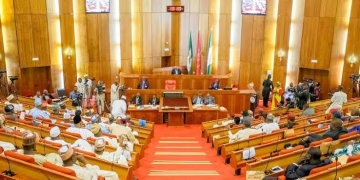
The scale of post-primary movement became impossible to ignore on March 31, 2026, when the House of Representatives convened what became, in effect, a formal defection ceremony.
Speaker Tajudeen Abbas read twenty-seven letters of defection into the record in a single session. Lawmakers from across party lines announced their departures with a matter-of-factness that revealed how normalised the practice has become within Nigeria’s legislative culture. There was no procedural uproar, no extended debate about the constitutional implications. The institution absorbed the moment and moved on, as it has done before and will do again.
The environment into which these defectors are moving, however, is considerably less hospitable than in previous cycles. The Peoples Democratic Party, which once governed the majority of Nigeria’s thirty-six states and held the presidency for sixteen unbroken years, has been reduced to a shadow of its former self. Today, it holds the governorship of just one state — a collapse so steep and so swift that it has fundamentally altered what opposition politics in Nigeria means in 2026. For a primary loser departing the APC in search of a viable alternative platform, that reality demands serious consideration. The legal right to defect and contest is one thing. The political infrastructure to mount a competitive campaign from a party governing a single state is quite another.
The judiciary, which has historically served as the final arbiter of defection disputes, adds a further dimension of uncertainty. Nigerian courts have, over successive electoral cycles, interpreted the Constitution’s division exception with a flexibility that critics contend stretches the provision well beyond its intended meaning. Lawmakers facing the loss of their seats have invoked internal party disagreements of varying credibility as justification for defection, and courts have, in numerous instances, accepted those justifications. Whether the stricter membership provisions of the Electoral Act 2026 will be enforced with corresponding rigour, or whether creative legal arguments will once again find sympathetic judicial ears, is a question that will almost certainly be tested before the 2027 elections conclude.
What Nigerian law says, at its core, is this: a primary loss is not an electoral death sentence. The right to seek office does not expire the moment a party congress produces an unfavourable result. But the Electoral Act 2026 has introduced a discipline into the defection process that Nigerian politics has not previously demanded. It has made preparation, foresight, and legal literacy the determining factors in whether a primary loss becomes a temporary setback or a permanent conclusion.
For those who read the law, registered accordingly, and kept their options open, the path to 2027 remains navigable. For those who did not, the lesson is an expensive one — and it arrives, as the most consequential lessons always do, precisely when there is no longer time to act on it.
_For comments, reflections, and further conversation:
Email: samuelagogo4one@yahoo.com
Phone: +2348055847364_