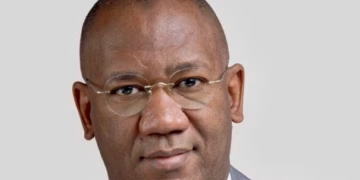


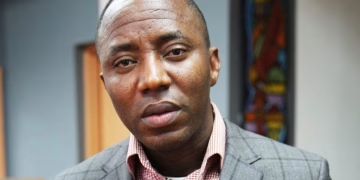


In the often turbulent theatre of Nigerian politics, where praise is seasonal and loyalty rented by the highest bidder, the words of Senator Yusuf Datti Baba-Ahmed carry a particular weight. A man of intellectual sharpness, founder of Baze University in Abuja, former Senator for Kaduna North, and the Labour Party’s vice-presidential candidate in 2023, Datti is not the type to offer cheap flattery. When he opens his mouth about Peter Obi, Nigeria listens.
“There are two individuals that I would succumb to,” Datti once told Channels Television, when asked whether he would run again with Peter Obi in 2027. “The second one is Peter Obi — and always Peter Obi, until he decides not to.”
But it is his deeper, more personal assessment of Obi’s character that has resonated far beyond political circles. Datti has consistently described Peter Obi as the kind of figure who comes along only once in a generation — a man whose record is so unusually clean that those who privately search for scandal to use against him return empty-handed. In Datti’s own words across multiple interviews, Peter Obi is a prudent man — careful, measured, and untarnished by the controversies that shadow virtually every other major Nigerian political figure.
“Peter Obi is a very easy person. He leaves you to use your judgement and initiative,” Datti observed during one interview, adding that despite the burdens of political life, Obi has maintained consistent communication, respect, and transparency in all their dealings.
The meaning behind these words is deeper than they appear. In a political landscape saturated with allegations, court cases, and international freezing of assets, Datti is essentially saying that Peter Obi is a different species entirely — a man so careful with money, so deliberate in governance, and so personally disciplined that the machinery of political attack grinds to a halt in his presence.
To understand Peter Gregory Obi, you must first understand where he came from. Peter Obi was born on July 19, 1961, in Onitsha, Anambra State — not just a city but a commercial civilization. The Onitsha Main Market is one of the largest in Africa, a place where fortunes are built from nothing, where the smell of ambition blends with the scent of new fabric and engine oil. Before the world knew him as a governor or presidential candidate, Peter Obi was the son of traders, growing up in a family where business was both a means of survival and a philosophy of life.
His father died when Peter was just nine years old, and rather than being crushed by grief, young Obi responded the only way a child raised in Onitsha’s commercial spirit could — he went to work. He began selling kerosene, buying from wholesalers and retailing in small quantities to neighbours. His mother, worried that early exposure to money would corrupt his academics, watched anxiously.
She needn’t have worried. The boy succeeded at both simultaneously.
By secondary school at the prestigious Christ the King College in Onitsha, he had moved from kerosene to eggs, then to shoe and cloth design, producing in large quantity and earning meaningful profits. He was already an established businessman before he sat his final exams. He later travelled to London with like-minded friends and began importing goods in containers — his first taste of international trade.
He went on to study Philosophy at the University of Nigeria, Nsukka, graduating in 1984. Philosophy — the study of reason, ethics, and the nature of truth — was not a random choice. It would later reveal itself in his meticulous approach to governance, his insistence on facts and data, and his remarkable ability to remain calm when others erupt.
His thirst for knowledge did not stop there. He trained at Harvard Business School, the London School of Economics, Columbia Business School, Oxford’s Said Business School, Cambridge’s Judge Business School, and the International Institute for Management Development in Switzerland. This is the academic resume of a man who took his own mind seriously — who understood that the most dangerous form of poverty is ignorance at the top.
Armed with philosophy, global business training, and the street education of Onitsha’s markets, Obi entered the corporate world with rare clarity. He became Chairman of Fidelity Bank — remarkably, the youngest person to hold such a position at a major Nigerian bank. He chaired several other companies including Next International Nigeria Ltd, Guardian Express Mortgage Bank, and Future View Securities Ltd. He also served as Chairman of the Securities and Exchange Commission, bringing the same rigour and transparency to Nigeria’s capital market that would later define his governorship.
His financial knowledge helped him maintain his integrity throughout — he was consistently lauded for managing resources efficiently and avoiding financial scandals across every institution he touched.
No story of Peter Obi’s public life would be complete without addressing the Abacha question — an episode that critics tried repeatedly, and unsuccessfully, to weaponize against him. When news emerged that Obi had some form of engagement with the Abacha era, it became fodder for political attacks. The truth was far simpler than his opponents hoped.
Obi clarified publicly that his engagement came in the context of a task force aimed at decongesting Nigeria’s ports in the 1990s, initiated by a group of importers and traders who were frustrated by prolonged delays in clearing goods.
“We approached him not as political actors,” Obi stated, “but as concerned citizens seeking pragmatic solutions to a matter affecting economic activity and livelihoods.” Evidence confirmed it was a temporary, non-political role lasting less than four months. When people went digging for something truly damaging — something career-ending — what they found was a businessman who once helped unclog a port. The weapons aimed at him hit rubber. This, Datti says, is precisely what makes Obi generational. The scandal hunters always come back disappointed.
In March 2006, after a bruising three-year legal battle following a massively rigged 2003 election, Peter Obi was finally sworn in as Governor of Anambra State. He arrived to find a state in financial ruin — debts stacked upon debts, civil servants owed months of salary, and virtually nothing left in the treasury.
What followed over the next eight years became the most talked-about governance record in modern Nigerian history.
He returned schools to their original owners — the churches and mission agencies that had built them — and partnered with them seriously in education delivery. The result was extraordinary: Anambra moved from 24th position out of 36 states to Number One in both NECO and WAEC examinations for three consecutive years. He built the first state-owned teaching hospital, upgraded healthcare facilities across the state, constructed over 800 kilometres of roads, attracted investments including the SABMiller brewery and the Innoson Motors plant, and initiated the first Sub-Sovereign Wealth savings programme in Sub-Saharan Africa.
But the achievement that made every Nigerian’s jaw drop — the one that no other governor had done — was the money he left behind. When he handed over to his successor in 2014, Anambra had accumulated over $150 million in savings. There were no unpaid salaries, no unpaid pensions, no pending contractor bills. The Nigerian Debt Management Office rated Anambra the least indebted state in Nigeria. The Senate rated it the most financially stable. He achieved all of this without borrowing a single naira or raising bonds.
Stories about him became legend: flying economy class on domestic routes while other governors chartered private jets; carrying his own luggage through airports; rejecting the extravagant security convoys Nigerian officialdom treats as a birthright; questioning every naira of public expenditure. These were not performances for cameras. They were the deeply ingrained habits of a man who had learned the value of money carrying kerosene bottles in Onitsha at age nine. The boy from the market never forgot where he came from — and that memory shaped every decision he made in power.
Peter Obi’s reputation has not been confined to Nigerian shores. The Center for Strategic and International Studies described him as a distinguished Nigerian businessman and reform-minded politician whose leadership is defined by integrity, transparency, and a steadfast commitment to people-centered development. The Global Peace Foundation recognised him as a distinguished leader widely recognised for his contributions to public policy, good governance, international business, and 21st-century leadership.
Former President Olusegun Obasanjo endorsed his 2023 presidential candidacy without reservation — a move that sent powerful signals both domestically and internationally. World-renowned author Chimamanda Ngozi Adichie was equally unequivocal. “My support for Mr. Peter Obi is based on his track record, personal experience, and the real things he has demonstrated over time,” she stated firmly, dismissing suggestions that her endorsement was tribal. She went further in a viral open letter, describing the 2023 election process as deeply flawed and demanding international scrutiny. “He doesn’t need to be president,” she wrote. “He wants to be because he genuinely cares about Nigeria — and that’s an important distinction.”
The Council on Foreign Relations observed that if any single factor explains Obi’s rise to political prominence, it is the belief among his followers that he is a rare breed who has somehow managed not to fall prey to the usual temptations of public office in Nigeria.
The Obidient movement that grew around Peter Obi in 2023 was unlike anything Nigeria had seen before. It was not created by a party machine, not funded by oil money, and not manufactured by political consultants. It emerged spontaneously from millions of young Nigerians — professionals, students, diaspora members, market traders, and first-time voters — who organised themselves on social media, raised funds independently, monitored polling units voluntarily, and created the most energetic grassroots political movement the country had witnessed in decades.
The movement drew its strength not from propaganda but from a verifiable record. You could look up the education rankings. You could find the savings figures. You could read the international awards. This was not blind political faith — it was evidence-based hope. In the 2023 election, despite the weight of two deeply entrenched parties and the full apparatus of incumbency deployed against him, Peter Obi won eleven states and the Federal Capital Territory. The establishment was shaken in a way it had not been in a generation.
This is precisely what frightens the political old guard. Peter Obi is dangerous to them not because he is violent or unpredictable, but because he is clean. In an ecosystem built on a mutual understanding of impunity, a man who cannot be blackmailed is a man who cannot be controlled. The Obidient Movement has publicly accused the ruling party of orchestrating schemes to prevent Obi from contesting in 2027 — pointing to deliberate destabilisation of his former party and legislative manoeuvres targeting his new platform. The sheer energy invested in stopping one man is itself the most powerful testimony to how seriously the establishment takes him.
The lessons Peter Obi offers Nigerian politicians — indeed all African politicians — are not complicated. They are simply and consistently ignored.
Prudence is not weakness. A government can save money and still build hospitals and schools. The personal lifestyle of a leader is their first policy statement — when Obi flew economy class, he sent a message to every civil servant that this government did not exist to enrich its officials. A clean record is a political asset more durable than any alliance. Education is the only sustainable investment. And organic support built on shared values outlasts every naira spent buying a vote.
His nickname among those who knew him before the world did is deeply telling — Okwute, meaning Rock. Not the most glamorous of names, but perhaps the most accurate. Rocks do not bend with the wind. Rocks do not erode with every political season. Rocks endure.
When speaking before American senators, Peter Obi said what few African leaders dare say in such rooms: “Africa doesn’t need aid. Africa needs leadership. We have over 30 percent of the world’s minerals, 60 percent of our arable land is uncultivated, and over a billion youth in their productive ages. If you can harness that, nobody can challenge you.”
That is the voice of a man who traded kerosene in Onitsha at age nine, who built businesses across continents, who saved over $150 million for a state he found in ruins, who flew economy class when the world expected private jets, and who, after every attempt to implicate him, left his accusers empty-handed and deeply embarrassed.
Senator Datti Baba-Ahmed is right. Someone like Peter Obi happens in a generation. The question that history is still writing is whether Nigeria — a country that has so often failed to make the right choice at the defining moment — will recognise its generation when it arrives.
The kerosene seller from Onitsha is still standing. The verdict belongs to the people.
For comments, reflections, and further conversation:
Email: samuelagogo4one@yahoo.com
Phone: +2348055847364