











Freedom of speech is one of the most important rights we hold, but rights are never meant to be exercised without responsibility. When freedom of expression is twisted into a weapon, it ceases to be liberating and instead becomes destructive. Across billions of screens, social media has become a space where expression is often weaponised, eroding childhood innocence, endangering the elderly, and undermining our shared sense of dignity. The damage is not abstract. It is visible, measurable, and in many cases irreversible.
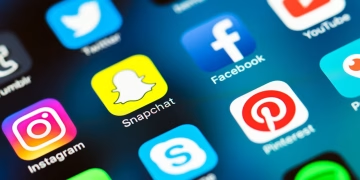
Social media has reshaped the modern world in extraordinary ways. It has given young entrepreneurs the chance to build businesses from their bedrooms, amplified voices that traditional media ignored, and kept families connected across continents. Platforms like TikTok, Instagram, Facebook, YouTube, and Snapchat now reach more than 5 billion people, with that number expected to surpass 6 billion by 2028. For millions of young people, these platforms are not just entertainment — they are classrooms, workplaces, and communities. These contributions are real, and they deserve recognition. Yet alongside these benefits lies a darker reality. The same platforms that empower and connect also exploit and endanger. Harmful content is not a minor glitch in the system; it is woven into the very design of the platforms themselves. And because the system rewards extremity, the problem cannot be solved with voluntary guidelines alone.
The driving force behind much of this harmful content is not creativity but the pursuit of engagement. Social media platforms are built to reward outrage, shock, and sensationalism because those emotions generate the most clicks. More clicks mean more advertising revenue. This creates a dangerous incentive structure: the more extreme the content, the greater the reach, and the greater the financial reward. Creators, many of them young and impressionable, are pressured to push boundaries further with each upload. What was shocking yesterday becomes normal today, and tomorrow demands something even more outrageous. It is a race to the bottom, and the finish line is often tragedy.
The consequences are not hypothetical. They are documented, recurring, and sometimes fatal. Violent pranks staged on unsuspecting strangers cause psychological trauma and medical risks, especially for vulnerable people like the elderly. Viral challenges have claimed lives — from the Cold Water Challenge in 2014 to Neknomination, which was linked to multiple deaths. Other trends encourage children to inhale aerosols or chemicals, leading to brain damage, addiction, and sudden cardiac death. Sexualised performances, often skirting the edge of platform policies, are freely accessible to minors. What begins as a viral trend on a screen can end as a funeral in real life.
Perhaps the most urgent dimension of this crisis is its impact on children. Despite age restrictions, millions of minors use platforms daily. Research has found tens of millions of harmful posts on Instagram and TikTok, including content related to suicide and eating disorders. Even toddlers watching child-friendly videos on YouTube face a measurable risk of being algorithmically directed to inappropriate material. Studies link regular consumption of short-form video to heightened anxiety and depression in children. School nurses report treating injuries from social media stunts. Parents often remain unaware of the dangers their children face online. This is not anecdotal. It is a public health emergency unfolding in plain sight.
Any serious discussion of regulation inevitably encounters the objection of free speech. This concern is valid. Freedom of expression is foundational, and censorship has historically been used to silence dissent. But regulating harmful content is not censorship. As the UN High Commissioner for Human Rights stated in 2025, unregulated digital spaces do not produce greater freedom — they silence vulnerable voices and allow hatred to flourish. Content that endangers life, exploits children, or normalises abuse does not fall under any principled definition of protected speech. Properly designed regulation does not compete with free expression; it protects it.
Platforms have not been entirely passive. YouTube banned dangerous challenges in 2019. TikTok and Instagram removed a portion of self-harm content in 2025. Meta shifted focus to high-severity violations. These steps matter, but they are far from enough. Creators routinely evade guidelines by misspelling banned terms, exploiting algorithmic blind spots, or migrating to less regulated platforms. The deeper problem is structural: the business model itself is built on engagement, and engagement rewards the very content that causes the most harm. Voluntary guidelines cannot fix a system designed to profit from outrage.
The solutions must be enforceable, not optional. Governments must enact legislation that holds platforms legally accountable for harmful content, especially when minors are exposed. Financial penalties should attach to failures of content governance. Age verification must move beyond self-declared birthdays to credible systems — document-based or biometric verification, supported by parental consent. Algorithms must be subject to independent audits, with penalties for platforms that surface dangerous material to vulnerable users. Platforms should publish clear, enforceable content policies with independent appeals mechanisms. Schools must embed digital literacy into curricula, equipping children to recognise manipulation and understand how algorithms shape their online experience. Parents need effective monitoring tools, not superficial controls. Creators with large audiences must face consequences — demonetisation or suspension — for persistent violations. And because harmful content crosses borders effortlessly, international frameworks are essential to establish baseline standards globally.
This argument is not against young creators. Social media has given them opportunities, careers, and communities. But creativity is not recklessness, and entertainment is not exploitation. The creators who leave lasting legacies are those who inform, inspire, and uplift — not those who endanger strangers or degrade themselves for clicks. Regulation is about cultivating an environment where authentic talent thrives without compromising integrity.
Social media is here to stay. The question is not whether it will exist, but what standards of responsibility we demand of it. We do not allow television to broadcast explicit content to children in the afternoon. We do not permit radio to incite harm without consequence. We do not accept print media endangering public safety under the guise of freedom. There is no reason the internet should be held to a lesser standard. Censoring harmful content is not suppression. It is governance — the act of protecting the vulnerable, upholding values, and demanding accountability from the most powerful communication platforms in history. A grandmother should not fear for her life because her terror is monetised. A child should not be scarred by algorithmic exposure before they can understand what they see. A young creator should not be forced to choose between integrity and income. Content without consequence is not freedom. It is negligence. And negligence, at this scale, is no longer acceptable.
For comments, reflections, and further conversation:
Email: samuelagogo4one@yahoo.com
Phone: +2348055847364