



In the aftermath of the U.S. Air Force rescue mission that saw billions of dollars committed to saving two downed airmen, the world was reminded of how far America will go to protect its own. The operation was massive, involving the Air Force, Navy, Army Special Operations Command, Marine Corps aviation units, and even the Central Intelligence Agency. Multiple aircraft were deployed—MC‑130J Commando II transports, HH‑60W Jolly Green II helicopters, HC‑130J Combat King II tankers, A‑10 Thunderbolt II jets, and surveillance drones. At least two MC‑130Js, each valued at over $100 million, were destroyed to prevent capture. Analysts estimate the total cost of the mission at between $500 million and $2 billion. For Washington, the price was justified. The message was clear: no American will be left behind.
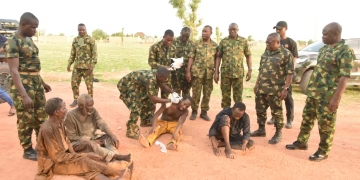
Nigeria’s reality could not be more different. Brigadier General Musa Uba was ambushed and killed by ISWAP terrorists in Borno State. Other senior officers have been kidnapped or assassinated. Soldiers and civilians alike are abducted daily across highways, schools, and villages. Unlike America’s daring rescue, Nigeria’s response is often limited to press statements condemning attacks. Rarely are high‑risk rescue missions mounted. Families are left to negotiate ransoms, morale within the armed forces suffers, and citizens lose faith in the state’s ability to protect them.
The welfare of Nigeria’s military personnel adds another painful dimension. One soldier, after spending more than three years fighting insurgents in Maiduguri, publicly called out politicians, urging their children to join the fight against insurgency. His bold statement drew national attention but also cost him his career—he was relieved of his duties shortly after. Following his dismissal, he made a shocking revelation about the welfare of military personnel. He disclosed that many earned as little as ₦50,000 monthly, later increased to just over ₦100,000, despite risking their lives daily. He went further to explain that soldiers often buy their own boots, uniforms, and even body armor.
This reality is not limited to the army alone. The police and other paramilitary agencies, who also face grave risks daily, endure similar struggles. They stand on the frontlines against crime, terrorism, and insurgency, yet their welfare packages remain inadequate. These men and women use their bodies as shields for the nation, but their compensation and support are far from commensurate with the dangers they confront.
Our military and paramilitary forces can end this foolish and destructive insurgency in Nigeria—but only if the government demonstrates the political will to empower them fully and instruct them to finish the fight. Without decisive leadership, their sacrifices are undermined, and the insurgents remain emboldened.
If billions are budgeted for equipment, then the welfare of the military, police, and paramilitary forces must also be a priority. The insurgency should never be more motivated than the forces tasked with defeating it.
From students abducted in Kaduna to farmers taken in Zamfara, kidnappings have become routine. Each incident chips away at public trust. Nigerians see their government issue statements, but not decisive action. This inaction emboldens terrorists and bandits, who now view kidnapping as a lucrative enterprise. The absence of daring rescue missions signals to both citizens and enemies that Nigerian lives are negotiable.
The contrast is stark. America values one soldier’s life enough to risk billions and mobilize its entire military and intelligence community. Nigeria struggles to protect even its generals, let alone its citizens. Worse still, Nigerian military, police, and paramilitary personnel—who stand as human buffers against insurgency and crime—are underpaid, under‑equipped, and neglected.
If Nigeria is to restore confidence in its armed forces and protect its people, it must rethink its security priorities, invest in rescue capabilities, and demonstrate—through action, not words—that every Nigerian life matters, and every Nigerian defender deserves better.
For comments, reflections, and further conversation:
📧 Email: samuelagogo4one@yahoo.com
📞 Phone: +2348055847364