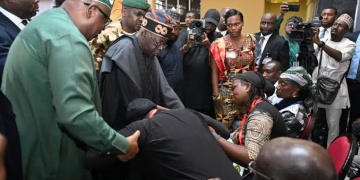





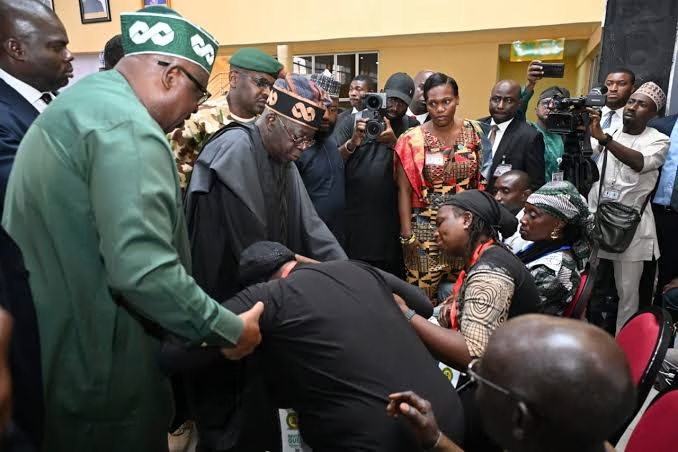
The recent visit of the President to Jos, Plateau State, to commiserate with victims of the latest wave of violence has stirred mixed reactions across Nigeria. While many citizens welcomed the gesture as a sign of empathy and solidarity, others expressed disappointment at the manner in which the visit was conducted.
The President’s decision to stop at the airport to meet with state officials and victims, rather than visiting the actual scenes of devastation, left many Nigerians troubled. For them, the symbolism of standing with grieving families in their communities carries far more weight than a brief airport meeting. This echoes similar criticisms from his visit to Benue, where he stopped at the Government House instead of engaging directly with affected persons.
In the aftermath of previous tragedies, such as the Maiduguri bomb blast, directives for service chiefs to relocate temporarily to the region brought some relief. Yet, with killings persisting across Plateau, Benue, Kaduna, Zamfara, Katsina, Niger, Kebbi, and Borno, Nigerians are questioning whether promises of deploying 5,000 CCTV cameras will truly make a difference.
Nigerians have raised pressing concerns: Will CCTV cameras genuinely deter attackers or help identify culprits, such as those seen in amateur videos circulating online? What guarantees exist that these cameras will not be compromised or vandalized? Will the deployment extend beyond Plateau to other hotspots? And are there stronger, more immediate security measures than surveillance technology?
The outrage was further fueled by a viral amateur video near the University of Jos, where some individuals were seen beating an innocent young man almost to death. The footage shocked the nation, with many demanding immediate arrests of those clearly identifiable in the video. For citizens, this incident underscored the urgent need for accountability and visible justice. If perpetrators caught on camera are not prosecuted, then promises of CCTV cameras risk being seen as hollow.
Security experts suggest that long-lasting solutions must go beyond surveillance. These include community policing and local intelligence networks to build trust and detect threats early, integrated intelligence fusion centers to coordinate military, police, and civilian security efforts, judicial accountability and swift prosecution of perpetrators to end impunity, socio-economic interventions such as job creation, education, and rural development to reduce recruitment into violent groups, border security and arms control to stem the flow of illegal weapons fueling attacks, and peacebuilding initiatives that foster dialogue between communities and reduce ethnic or communal tensions. Many Nigerians also argue that with the scale and persistence of killings, declaring a state of emergency in some of the worst-hit areas may be the only way to restore order and demonstrate seriousness in tackling the crisis.
The President’s visit was further marred by the lack of electricity at the Jos airport, a detail many interpreted as an indictment of governance. While the state government could have powered generators for appearances, the blackout symbolized deeper infrastructural neglect. More troubling to citizens was the President’s remark that he had “10 minutes” to spare for victims and officials—a statement perceived as dismissive of the gravity of their suffering.
Beyond gestures and promises, Nigerians are demanding concrete action. How many perpetrators of these killings have been arrested? How many have been prosecuted and brought to justice? Without visible accountability, empathy risks being seen as hollow rhetoric.
At the heart of the matter lies a fundamental truth: every citizen deserves to live in safety and dignity. When lives are lost with little consequence, and when government responses appear detached from the pain of ordinary people, trust in leadership erodes. The President’s visit to Jos was meant to heal wounds, but for many, it has instead highlighted the gap between symbolic gestures and substantive action.
For comments, reflections, and further conversation:
Email: samuelagogo4one@yahoo.com
Phone: +2348055847364