






As Nigeria moves steadily toward the 2027 general election, political debate is becoming sharper, louder, and more strategic. Questions continue to dominate public discussion: whether President Bola Ahmed Tinubu is benefiting heavily from incumbency, whether opposition parties can overcome internal divisions, and whether democratic institutions will face another major credibility test.
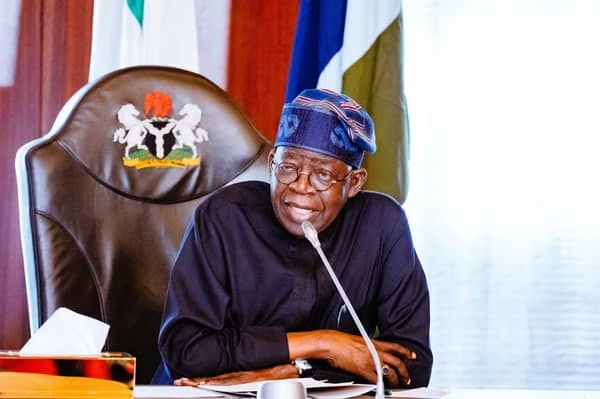
Yet beyond emotional commentary, one political reality remains difficult to ignore: at this stage, Tinubu still appears to be the most structurally prepared political actor in the field.
This does not automatically mean victory is guaranteed, nor is it an endorsement of every government policy. It simply reflects Nigeria’s political history, where elections are rarely won by public frustration alone. They are won through organisation, alliances, timing, field structures, and political endurance.
Tinubu’s present strength did not begin in office. For over two decades, he has remained one of Nigeria’s most deliberate political builders. From the post-June 12 democratic era to the coalition that helped deliver the 2015 victory of Muhammadu Buhari, he consistently invested in long-term structures while others often focused only during election seasons.
He supported candidates, built alliances, survived political betrayals, and cultivated networks across regions. His political interactions over the years with figures such as Atiku Abubakar and Nuhu Ribadu mean he entered office already familiar with many of the personalities now considered possible challengers.
A major example of that endurance came during the 2022 APC Presidential Primary, when many powerful interests did not expect him to secure the ruling party ticket. He prevailed before controlling federal institutions, which remains one of the strongest indicators of his political resilience.
Now as incumbent, he combines constitutional authority with an already mature political machine. Like previous presidents — Olusegun Obasanjo, Umaru Musa Yar’Adua, Goodluck Jonathan and Muhammadu Buhari – presidential appointment powers naturally strengthen influence across ministries, agencies and institutions. In Tinubu’s case, that authority rests on an already established political network.
The electoral timetable also favours early organisation. With Independent National Electoral Commission primaries expected well ahead of the 2027 polls, the compressed calendar benefits parties already settled around one central figure. At present, the ruling All Progressives Congress appears more coordinated around one candidate than any major opposition platform.
By contrast, Peoples Democratic Party continues to struggle with internal divisions, Labour Party still faces leadership uncertainty, while African Democratic Congress and other parties remain in varying stages of coalition discussion.
Names such as Peter Obi, Atiku, Rotimi Amaechi, Seyi Makinde, Rabiu Kwankwaso and Adebayo Adewole continue to circulate strongly, but names alone do not win elections in Nigeria. Polling-unit presence, ward coordination, legal defence, vote collation and disciplined national structures remain decisive.
One major current advantage for Tinubu is the steady movement of governors, legislators and influential political actors toward the ruling party. Defections often reflect where politicians perceive durability, negotiation strength and future relevance.
Yet defections also expose one of Nigeria’s democratic weaknesses. In many advanced democracies, elected officials who change parties are often expected to return to voters through by-elections before retaining public office under a new platform. In Nigeria, however, politicians frequently decamp while keeping mandates won under entirely different party identities.
That practice may strengthen short-term political convenience, but it weakens ideological accountability. A stronger democratic future may require serious national reflection on whether major defections; particularly by governors, senators and legislators – should automatically trigger by-elections. Such a reform would deepen voter ownership, reduce opportunistic movement, and strengthen party discipline across the political system.
At the same time, defections should not automatically be mistaken for guaranteed voter transfer. Governors often command institutional structures, appointments and cabinet influence, but grassroots voting behaviour can differ sharply from elite movement. Political arithmetic at government house level does not always equal emotional support among ordinary citizens.
Economic hardship remains Tinubu’s strongest vulnerability. Inflation, insecurity challenges, cost of living, subsidy consequences and exchange-rate pressures continue to shape public frustration. However, hardship alone has rarely removed incumbents in Nigeria without disciplined electoral conversion by opposition forces.
Another caution for the ruling party lies in some of the loudest political defenders around the president. Certain highly visible promoters were once among his strongest critics, using severe language against him in earlier periods. For many citizens, sudden political reversals do not always attract trust; sometimes they create doubt.
In politics, credibility often persuades more than volume.
When former harsh critics suddenly become aggressive defenders, they may not necessarily bring new supporters; in some cases, they remind undecided voters of past accusations and deepen public suspicion. Political communication can therefore help a government or quietly weaken its wider brand, depending on who delivers the message.
A major strategic variable remains former President Goodluck Jonathan. Jonathan still retains unusual acceptance across parts of northern Nigeria and may be viewed by some northern political actors as a southern figure capable of completing a broader southern power cycle, especially because he has already served one elected term and may naturally be seen as a likely one-term transitional option if he re-enters national politics. Through all these calculations, Atiku also remains present in the wider equation.
However, perhaps the strongest realistic electoral challenge to Tinubu may come if Obi and Kwankwaso move beyond public speculation into full political alignment.
That combination would unite two major strengths: Obi’s strong southern, youth and reform-driven appeal, and Kwankwaso’s established northern grassroots base, particularly in Kano and across parts of the North-West.
Recent enthusiasm around both names shows that this possibility already carries emotional energy. Supporters openly projecting an Obi–Kwankwaso understanding suggest that many citizens see such a coalition as a serious alternative.
Its strategic value goes deeper.
Obi, as a southerner and Christian, naturally fits into Nigeria’s long political balancing tradition where religious and regional combinations often shape ticket acceptability. A Kwankwaso partnership would immediately introduce a Muslim northern balance that many political observers believe still matters in national electoral arithmetic.
There is also another quiet political calculation: after eight years of northern leadership under Buhari, some Nigerians still believe the South should complete another eight-year cycle. In that context, a strong southern candidate may also be viewed by some as a possible one-term southern figure completing that broader balance, depending on coalition agreements and elite negotiation.
But coalition excitement alone is not enough.
Such a partnership would still require mutual concessions, disciplined structures, funding clarity, legal preparation and nationwide coordination.
Ultimately, 2027 may not simply become APC versus opposition.
It may become APC versus national mood captured through a party, a coalition, or a single disciplined candidate.
But in Nigeria, mood alone has never been enough without electoral machinery.
The real challenge to Tinubu is not anger, not social media energy, and not elite speeches.
It is one opposition candidate, one national structure, one funding system, one legal defence network, and one disciplined field operation stronger than the ruling party.
Until that happens, Tinubu enters 2027 not merely as incumbent, but as the most structurally prepared politician currently standing on Nigeria’s national stage.
And in Nigerian politics, structure often defeats sentiment
By Mentoring Cmdt Alistair ✍🏽
Mentoring Cmdt Alistair is a UK-based entrepreneur, leadership advocate, and writer on governance, democracy and public affairs.
www.nidmecorp.com