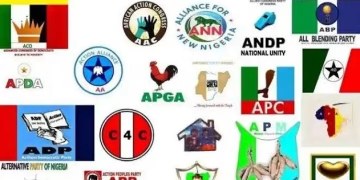











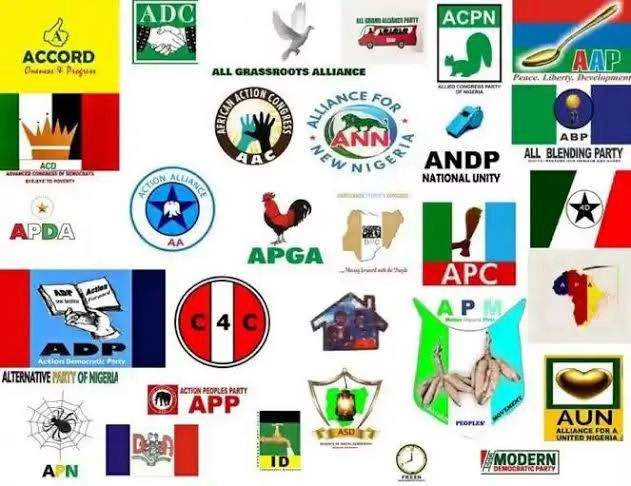
A major political storm is unfolding in Abuja as the National Forum of Former Legislators (NFFL) has approached the Federal High Court seeking the deregistration of several political parties, including the African Democratic Congress (ADC), Accord Party, Zenith Labour Party (ZLP), Action Alliance (AA), and Action Peoples Party (APP).
The suit alleges that these parties have failed to meet constitutional requirements for continued existence, particularly the electoral performance standards outlined in the Nigerian Constitution and Electoral Act. While the former lawmakers argue that democracy cannot be strengthened if parties exist only on paper, critics believe the move is a calculated attempt to shrink political competition ahead of the 2027 general elections.
The former legislators insist that their action is not political intimidation but a constitutional clean-up aimed at strengthening the electoral system. They argue that parties which consistently fail to win elections, secure meaningful votes, or maintain national relevance should not continue to appear on the ballot. However, many political observers are unconvinced. They believe the move is driven by fear—fear that smaller parties could become platforms for new alliances and opposition movements capable of challenging entrenched political structures in the next election. In today’s Nigeria, smaller parties are no longer irrelevant. They have become vehicles for reformers, youth-driven movements, and politicians who cannot find space in the major parties. Removing them could choke political diversity and weaken democracy itself.
This controversy has revived memories of Nigeria’s military era under General Sani Abacha. In 1996, only five political parties were allowed to exist, all widely believed to be controlled by the regime. By 1998, those parties unanimously adopted Abacha as their sole presidential candidate, leaving Nigerians with elections but no real choice. That period is remembered as democracy without freedom. Many fear that shrinking the number of parties today—even through legal means—could gradually recreate a similar atmosphere. Democracy is not only about strong, dominant parties; it is also about small voices, emerging movements, and political alternatives. Even a weak party represents a group of Nigerians. Even a struggling party reflects political freedom. If Nigeria drastically reduces the number of parties before 2027, the risk is that the country may move toward a system where only a few voices are allowed to survive.
History has a long memory. It remembers those who defended democracy and those who tried to weaken it. Nigerians still recall the lawmakers who resisted the controversial third-term agenda of former President Olusegun Obasanjo. Names like Ken Nnamani, Ibrahim Mantu, Uche Chukwumerije, Adolphus Wabara, Sule Yari Gandi, Usman Bugaje, Ben Obi, Abiola Ajimobi, Bala Ibn Na’Allah, and others remain etched in the nation’s democratic story. The question now is how history will remember today’s former lawmakers. Will they be seen as defenders of constitutional order, or as men who tried to silence political freedom before a crucial election?
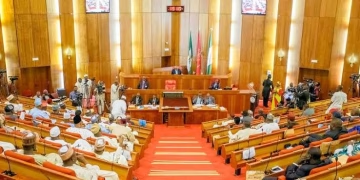
The stakes are high. The decision of the courts—and the political actors behind this move—will shape the democratic atmosphere of the 2027 elections. If deregistration is pursued purely for constitutional compliance, it may strengthen the system. But if it is driven by fear of competition, it risks undermining the very foundation of democracy. This message is not only for the former lawmakers pushing this agenda; it is equally applicable to present lawmakers, the judiciary, and the executive. Each arm of government carries the responsibility of safeguarding Nigeria’s democracy, ensuring that political freedom is not sacrificed for convenience or control.
According to reports circulating in the public domain, March 24 has been indicated as the date when the Federal High Court is expected to deliver its ruling on this matter. The world is watching closely to see how the judiciary will decide in this case, and the outcome will echo far beyond Nigeria’s borders as a test of the country’s democratic resilience.
As Nigeria prepares for 2027, the actions of today’s leaders will be judged not only by the courts but by history itself. Will they be remembered as protectors of democracy, or as architects of silence? Will they stand tall as defenders of political freedom, or be remembered as men who feared competition? History does not forget. And when the story of this moment is written, the names of those who defended democracy will shine, while those who tried to weaken it will remain in its shadows.
For comments, reflection and further conversation, email: samuelagogo4one@yahoo.com | Phone: +2348055847364