










Nigeria’s tourism wealth is vast, but it remains largely untapped. Across Africa, countries with fewer resources have transformed their landscapes into billion-dollar industries. Rwanda, scarred by genocide just three decades ago, now earns hundreds of millions annually from gorilla trekking. Kenya thrives on wildlife tourism, while Tanzania’s Kilimanjaro and Serengeti are global icons. These nations are not richer than Nigeria; they simply understood the value of their assets and chose to act. Nigeria, by contrast, has failed to recognize the fortune within its borders.
And nowhere is this neglect more glaring than in Taraba State — a land of mountains, waterfalls, cultural mysteries, and ecological riches. At its heart lies a giant that few Nigerians have heard of, yet it is the highest point in all of West Africa: Chappal Waddi.
Chappal Waddi rises to 2,419 metres (7,936 feet) above sea level, earning it the title “Roof of West Africa.” Locally, it is also known as Gangirwal, a Fulfulde word meaning “Mountain of Death” or “Mountain of the Dead.” The name reflects the ruggedness of the terrain and the myths surrounding it rather than actual fatalities. For the Mambilla people, the mountain carries spiritual significance, tied to cycles of fortune, agriculture, and myth. Oral traditions describe it as a place where ancient powers resided, making it more than just a physical landmark.
The mountain sits within Gashaka Gumti National Park, Nigeria’s largest protected area, and straddles the Nigeria–Cameroon border. It is part of the Bamenda–Alantika–Mandara mountain chain, a vast system of peaks and valleys that stretches across both countries. From its summit, climbers can see rivers winding through forests, valleys stretching into Cameroon, and the endless green of the Mambilla Plateau. Despite its grandeur, Chappal Waddi remains largely unknown. There are no internationally maintained trails, no certified guide industry, no lodges for trekkers, and no government-backed campaigns to market it to the world. The summit was only formally marked in 2020, and even then, it was not government officials who placed the marker but private citizens attached to a tour company. In other countries, such a peak would be celebrated as a national symbol, a magnet for adventure tourism. In Nigeria, it is treated as a curiosity.
Taraba’s mysteries extend beyond its mountains. At Kabri, embedded in rock, lies what local tradition describes as the giant footprint of an ancient warrior — a mark of dimensions that defy ordinary human scale. At Hienary, a rock bears what appears to be a horse’s footprint of similar size. These sites, surrounded by oral traditions, belong to the same category of cultural and geological mystery that draws visitors to South Africa, Peru, and Turkey. Yet they remain unknown even to most Nigerians. Imagine the tourism potential of a campaign built around “The Footprints of Giants,” drawing archaeologists, geologists, and curious travelers from across the world.
The gateway to this landscape is Gembu, a town perched high on the Mambilla Plateau. With its cool climate — daytime temperatures rarely exceeding 25°C — and rolling green hills, Gembu should be a hub of hotels, restaurants, and visitor centres. Instead, it remains underdeveloped, with poor roads and limited accommodation. Yet the plateau itself is a marvel: cattle ranches, Fulani pastoral traditions, and tea plantations of global scale. The Mambilla tea plantations are reported to be the second largest in the world, second only to one in India. Imagine plantation tours, tea tastings, agro-tourism education, and branded “Mambilla Tea” marketed internationally. Nigeria produces world-scale tea, but almost nobody knows it.
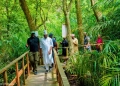
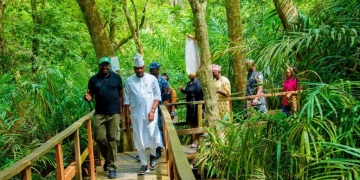
Encasing Chappal Waddi is Gashaka Gumti, Nigeria’s largest national park, covering nearly 6,000 square kilometres — three times the size of Greater London. It is home to the largest population of chimpanzees in West Africa. Leopards roam its forests, buffalo graze its plateaus, and its birdlife is so diverse that it could rival destinations already famous among global birdwatchers. Rwanda earns hundreds of millions of dollars annually from gorilla tourism in a smaller park. Nigeria has chimpanzees, waterfalls, mountains, and extraordinary biodiversity, yet the trickle of visitors to Gashaka Gumti barely registers in national revenue.
Tourism in Taraba could generate billions of naira annually if properly developed. The logic is simple: adventure tourism around Chappal Waddi could attract climbers and trekkers from across the world; cultural tourism around the Footprints of Giants, Ndumyaji Cave, and Killa Yang blacksmith site could draw historians, archaeologists, and curious travelers; agro-tourism around the Mambilla tea plantations could create a new industry of plantation tours, tastings, and branded exports; wildlife tourism in Gashaka Gumti could rival Rwanda’s gorilla trekking, attracting conservationists and ecotourists.
But for this to happen, the federal and state governments must act. Roads must be built and maintained. Electricity must be reliable. Internet connectivity must be established. Basic amenities — clean water, healthcare facilities, safe lodges — must be provided. Without these, tourists will not come, no matter how beautiful the landscape.
Nigeria’s unrealized tourism wealth stretches across the map. The Osun-Osogbo Sacred Grove, a UNESCO World Heritage Site, is a living cultural landscape of the Yoruba people. The Yankari Game Reserve in Bauchi harbours elephants, hippos, and warm springs. The Idanre Hills in Ondo rise dramatically from the earth, with ancient towns and shrines at their summit. Cross River State shelters critically endangered gorillas in its rainforests. Each of these sites could be a global attraction.
Chappal Waddi is not just Nigeria’s highest mountain; it is a symbol of natural grandeur, cultural depth, and untapped economic potential. Properly developed, it could stand alongside Kilimanjaro and Mount Kenya as a global destination for adventure tourism. For Nigeria, it represents a chance to diversify its economy, create jobs, and showcase its hidden treasures to the world.
Taraba’s mountains, forests, waterfalls, and cultural heritage are not curiosities — they are economic instruments waiting to be deployed. The footprints of giants are pressed into Taraba’s rocks. The question is whether Nigeria’s leaders will finally leave their own mark by turning this forgotten gold into lasting prosperity.
For comments, reflections, and further conversation:
Email: samuelagogo4one@yahoo.com
Phone: +2348055847364