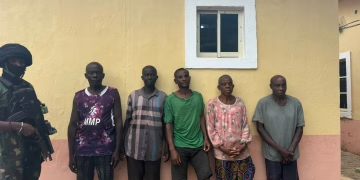

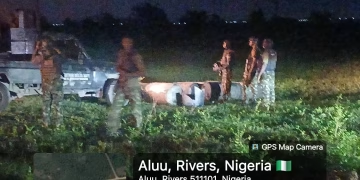


In the annals of global counterterrorism, few moments carry the weight of what unfolded in the early hours of Saturday, May 16, 2026. Across the rugged and unforgiving terrain of northeastern Nigeria — a land where the borders of Cameroon, Chad, and Niger converge in a vast theatre of dust, drought, and fragile human settlement — a joint military operation of extraordinary precision and audacity brought to a violent and decisive end the life of one of the world’s most feared and consequential terrorist commanders. His name was Abu-Bilal al-Minuki. And the world, from Washington to Abuja, from Lagos to London, exhaled.
Born in 1982 in the town of Mainok in Borno State, al-Minuki came of age in a region long scarred by insurgency, tribal conflict, and the progressive erosion of state authority. He was not a man who wore his ambitions openly. He did not seek the spotlight of infamy that consumed others of his kind.
Instead, he operated from the shadows — building, connecting, financing, and directing — accumulating power with the quiet patience of a man who understood that the most dangerous commanders are those the world does not see coming.
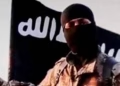
Rising through the ranks of extremist networks operating in the Lake Chad Basin and the broader Sahel region, al-Minuki became the central figure of the Islamic State West Africa Province, known internationally as ISWAP, a Boko Haram splinter faction formally aligned with ISIS’s central command in Iraq and Syria. Over time, he developed into the most consequential operational and financial architect within ISIS’s expanding African network. Security assessments and counterterrorism intelligence identified him as a senior official linked to ISIS’s General Directorate of Provinces — the secretive body that oversees the group’s international branches — and connected him to the al-Furqan Office, one of ISIS’s most powerful regional financial and operational coordination networks in Africa. His portfolio was vast: overseeing logistics, coordinating militant operations across multiple frontiers, and channelling international funding to ISIS-linked cells operating throughout the continent.
He was not a man who fought in the trenches. He was something far more dangerous — a strategist, a financier, and a shadow architect of mass murder. His relationship with Abubakar Shekau, the notorious and feared commander of Boko Haram, was complicated and frequently tense. When ISIS requested fighters to be deployed to Libya sometime between March 2015 and early 2016, Shekau flatly refused. It was al-Minuki who defied that directive, secretly dispatching fighters from ISWAP’s Lake Chad division — an act that deepened the fracture between the two men and marked al-Minuki as the primary bridge between West Africa’s homegrown terror and the global ambitions of ISIS central command. He was not merely a loyalist. He was an empire builder, methodically expanding ISIS’s African footprint at a time when the group was being militarily decimated on the battlefields of Syria and Iraq.
In June 2023, the United States State Department took the significant step of formally designating al-Minuki a Specially Designated Global Terrorist. His assets were frozen. American citizens and financial institutions were prohibited from any dealings with him. The designation was an unmistakable declaration of intent: Washington had identified its target, and the machinery of the most powerful intelligence and military apparatus on earth had begun to turn. Confident in the vastness of the African continent and the labyrinthine complexity of its ungoverned territories, al-Minuki dismissed the threat. He believed Africa would protect him. He was fatally mistaken.
For months stretching into years, American intelligence agencies maintained a patient, exhaustive, and extraordinarily methodical surveillance operation tracking his movements across the Sahel. The Lake Chad region is one of the most challenging counterterrorism environments on earth: geographically immense, politically fragmented, and largely beyond the reach of conventional law enforcement. Yet the United States was relentless. MQ-9 Reaper surveillance drones, deployed as part of a broader American military presence supporting Nigerian forces, provided an unblinking aerial eye over al-Minuki’s known operational zones. Human intelligence sources embedded on the ground, combined with signals intelligence intercepted across multiple networks, enabled American analysts to construct a granular and increasingly precise portrait of the terrorist leader’s movements, associations, and vulnerabilities.
The partnership between Washington and Abuja was simultaneously being forged into a precision instrument of war. Following earlier operations conducted in late 2025, the United States had deployed approximately 200 troops and advanced surveillance assets to Nigeria to provide training and intelligence support to the Nigerian military.
Nigerian commanders contributed critical ground intelligence, offered logistical coordination, and provided the cultural and geographic context that American forces alone could not replicate. Between two sovereign nations, a shared and deadly resolve had crystallised.
Then came the night of Friday, May 15, 2026. The intelligence was confirmed. The order was given. The mission, months in the planning, was executed with flawless precision. American special operations forces and Nigerian troops moved as one, synchronised across every dimension of the operation. Before the African continent had stirred from its night’s rest, Abu-Bilal al-Minuki — ISIS’s global second-in-command, the most active terrorist in the world — was dead.
President Trump announced the outcome on his Truth Social platform late on Friday night, the words carrying the gravity of a historic moment. He declared that at his direction, brave American forces and the Armed Forces of Nigeria had flawlessly executed a meticulously planned and very complex mission to eliminate the most active terrorist in the world from the battlefield. He named the target directly and stated that al-Minuki had thought he could hide in Africa, but that intelligence sources had kept Washington informed of his every movement. He added that al-Minuki would no longer terrorise the people of Africa or help plan operations targeting Americans. He extended his gratitude to the Nigerian government for its cooperation and stated without equivocation that with al-Minuki’s removal, ISIS’s global operation had been greatly diminished.
The elimination of al-Minuki was not simply the killing of one man. It was the surgical dismantling of an entire command architecture — a network of finances, logistics, and operational planning that had sustained ISIS across the Sahel for more than a decade. With his death, that network lost its most capable engineer. The world woke on Saturday, May 16, 2026, to the knowledge that the most wanted operational commander of ISIS globally had been removed from the battlefield — not in Syria, not in Iraq, but here in Africa, the very continent where ISIS had believed it could grow beyond the reach of Western military power.
But to fully comprehend the significance of this moment, one must travel back five months — to Christmas night, 2025 — when the first thunder of this new chapter rolled across northwest Nigeria, and the era of ISIS impunity in West Africa began its irreversible collapse.
For much of late 2025, ISIS-linked militants — particularly a group known as the Lakurawa, operating with brazen and lethal boldness across Nigeria’s northwestern states — had been conducting a campaign of unbridled terror against civilian communities in Sokoto State and its surrounding region. Villages were attacked without warning. Civilians were slaughtered without mercy. Reports of Christians being specifically targeted reached Washington, where President Trump had been monitoring the deteriorating situation with mounting fury. In November 2025, he issued a stark and public warning: stop the slaughter of Christians, or face the full and devastating consequences of American military power. The terrorists did not listen.
On the night of December 25, 2025 — Christmas night — President Trump delivered on every word of that warning. At his personal direction, and that of Defense Secretary Pete Hegseth, and in full coordination with Nigerian authorities, U.S. Africa Command launched a series of devastating and precisely targeted strikes against ISIS encampments in Sokoto State. Tomahawk cruise missiles, fired from a U.S. Navy vessel operating in the region, tore through the darkness and obliterated two ISIS operational camps. The initial military assessment confirmed that multiple ISIS terrorists were killed. The camps, which had served as the nerve centres for the Lakurawa’s reign of terror, were utterly decimated.
Trump was unapologetic and historically deliberate in his announcement. He stated publicly that he had previously warned the terrorists that if they did not stop the slaughtering of Christians, there would be hell to pay — and that on Christmas night, that reckoning had arrived. He later revealed with evident satisfaction that the strikes had originally been scheduled for an earlier date, but that he had personally delayed them so they would fall on Christmas Day itself, declaring that every camp had been decimated. Defense Secretary Pete Hegseth added his own blunt and unambiguous assessment, noting that U.S. military forces are always ready and that ISIS had found out on Christmas night, promising that more operations were to come and expressing gratitude for Nigerian government support and cooperation.
The sky above the targeted encampments glowed a deep, violent red that Christmas night. In nearby villages, residents felt the ground itself tremble beneath them as the explosions rolled across the darkened horizon. It was not merely a military operation. It was a declaration issued in fire and fury — that the days of ISIS operating freely in the shadows of the West African Sahel were over.
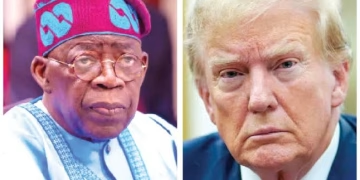
Nigeria’s government moved with purpose to affirm its full and unequivocal support. Foreign Minister Yusuf Tuggar revealed that he had held two conversations with U.S. Secretary of State Marco Rubio in the hours surrounding the strikes — one lasting 19 minutes before the missiles were launched, and a brief second exchange in the immediate aftermath. President Bola Tinubu had personally authorised the operation on Nigerian sovereign soil. Tuggar stated clearly that the Christmas strikes were not an isolated event but the commencement of an ongoing and sustained campaign, with other nations in the region expected to join the effort in the weeks and months ahead.
Taken together, the Christmas 2025 strikes and the May 2026 elimination of Abu-Bilal al-Minuki represent a defining and irreversible turning point in the war against ISIS in West Africa. They are not disconnected incidents of fortune or opportunism. They are the deliberate, sequential chapters of a coordinated long-game strategy — intelligence accumulation, force positioning, surgical military action, and the unrelenting pursuit of the highest-value targets — executed with a resolve that the region has rarely witnessed.
Nigeria has grappled for years with complex, deeply entrenched security challenges. Both Christians and Muslims have fallen victim to radical Islamist violence across its vast and varied territory.
The country, home to more than 237 million people and the largest economy on the African continent, cannot afford — and will no longer tolerate — the presence of a global terror network operating from within its borders. The partnership forged between Abuja and Washington in these operations represents a new standard for what sovereign cooperation in the face of existential security threats can and must achieve.
ISIS, while dramatically weakened since the collapse of its territorial caliphate, has demonstrated stubborn and dangerous resilience across Africa. ISWAP remained one of the group’s most operationally active affiliates, responsible for kidnappings, ambushes, bombings, and coordinated large-scale attacks across the Lake Chad Basin for years. With al-Minuki gone, that branch has lost not only its most senior commander but also the man most responsible for sustaining its international funding channels, strategic direction, and operational coherence.
Counterterrorism analysts caution that ISIS will seek to fill the vacuum. No criminal empire dissolves overnight with the death of a single commander. But the cascading blows delivered across five months — the Christmas night strikes, the troop deployments, the sustained drone surveillance campaigns, and now the elimination of the ISIS global second-in-command — have inflicted structural damage to ISWAP’s command apparatus that will require years to rebuild, if it ever fully does.
For the communities of the Lake Chad Basin, for the villages of Sokoto and Borno, for the farmers and herders and mothers and children who have lived under the suffocating shadow of terror for more than a decade — the message carried by these operations is unambiguous and absolute. No hiding place is remote enough. No desert is vast enough. No bush is thick enough. When two nations of consequence stand together in shared and unwavering purpose, the reach of justice knows no geographical limit.
Abu-Bilal al-Minuki, the man born in Borno who once believed that Africa itself was his fortress, his sanctuary, and his shield, has paid for that belief with his life. The war against ISIS in West Africa is not finished. But on the morning of Saturday, May 16, 2026, the darkness that has haunted this region for so long grew considerably, measurably, and irreversibly lighter. And the world took note.
For Comments, Reflections and Further Conversation
Email: samuelagogo4one@yahoo.com | Phone: +234 805 584 7364