




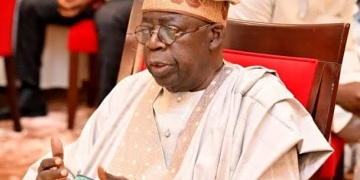





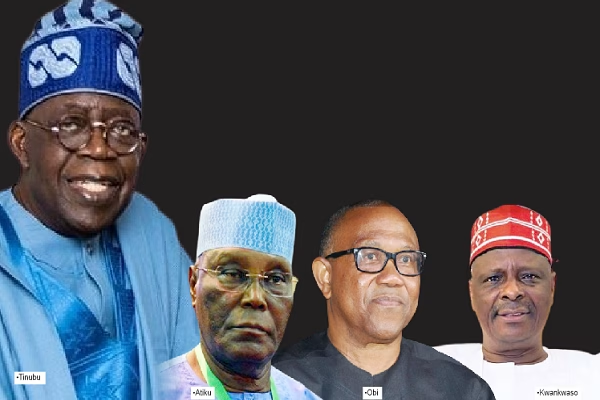
Nigeria’s democratic process has been jolted by a wave of controversy following the announcement of implausibly high vote figures by political parties during their internal primaries. The most striking case came from the All Progressives Congress (APC), which declared that President Bola Tinubu secured 10,999,162 votes in its primary election. This figure, critics point out, not only dwarfs his tally in the 2023 general election but also raises serious questions about the credibility of internal party processes and the integrity of Nigeria’s political system.
The announcement was met with immediate backlash from opposition leaders, civil society groups, and political analysts, many of whom described the figure as a “manufactured mandate.” Pat Utomi, a respected political economist, warned that such practices erode public trust and set a dangerous precedent for the country’s democratic future. He argued that inflating numbers to project dominance is not only deceptive but also corrosive to the legitimacy of genuine voter participation.
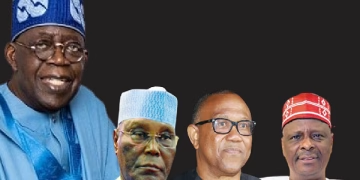
The APC is not alone in this practice. Other parties, including the People’s Democratic Party (PDP), the Labour Party (LP), and several smaller regional outfits, have also been accused of inflating internal vote counts during primaries and congresses. Analysts suggest that these exaggerated figures are often deployed as propaganda tools, designed to intimidate rivals, create a false sense of popularity, and manipulate public perception ahead of general elections. In a political environment where perception often shapes reality, such tactics can have profound consequences for the balance of power and the credibility of electoral outcomes.
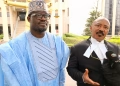
What makes the situation even more troubling is that some of these inflated numbers are being supervised or endorsed by respected leaders, religious figures, and clerics. Their involvement lends a veneer of legitimacy to practices that many Nigerians view as fraudulent. The moral weight of these figures is significant, and when they appear to stand by inflated claims, it sends a confusing message to the public. Our children are watching, and they will inevitably ask what and why politicians are counting and inflating figures. The example being set today risks shaping the political culture of tomorrow, embedding cynicism and distrust in the next generation of voters.
Attention has inevitably turned to the Independent National Electoral Commission (INEC), Nigeria’s electoral umpire, and its role in curbing these practices. While INEC is empowered under the Electoral Act 2022 to monitor party primaries for compliance, its jurisdiction is limited. Inflated figures announced for propaganda purposes often fall outside its enforcement powers, leaving the commission unable to impose direct sanctions unless fraud or falsification of official voter registers can be proven. This legal gap has fueled calls for reform, with civil society organizations insisting that INEC must be granted stronger authority to penalize parties that undermine democratic norms through fictitious claims.
The public reaction has been swift and unforgiving. Commentators across traditional and social media platforms have described the inflated figures as an “open disgrace” to Nigeria’s democracy, questioning why INEC has not imposed penalties and demanding greater accountability from political parties. Social media has been flooded with criticism, with many Nigerians expressing frustration that their democratic rights are being trivialized by parties more interested in optics than transparency.
The implications of these developments are far-reaching. Inflated figures undermine confidence in Nigeria’s electoral system, delegitimize genuine voter participation, and risk setting a precedent that could spill into the 2027 general elections. If unchecked, the practice of manufacturing mandates could destabilize the democratic process, erode trust in institutions, and weaken Nigeria’s standing as Africa’s largest democracy.
For now, the controversy serves as a stark reminder that democracy is not only about casting ballots but also about protecting the integrity of every stage of the electoral process. As Nigeria prepares for future elections, the challenge will be to ensure that political parties are held accountable, that INEC is empowered to act decisively, and that the voices of real voters are not drowned out by phantom numbers designed to deceive.
_For comments, reflections, and further conversation, email: samuelagogo4one@yahoo.com or call +2348055847364_